Makharij al-Huruf
The articulation points of every Arabic letter
Makharij (مخارج) are the physical points of articulation from which Arabic letters are pronounced. They are the foundation of tajweed: if the letter does not come from its proper place, no amount of rules will fix the sound. This page focuses on awareness, not memorization. The goal is to know where each sound comes from and what moves to produce it.
Makharij are learned by sound, not sight.
Diagrams help you understand what is happening in the mouth, but they cannot teach you the sound. Listen, imitate, repeat aloud. Silent learning does not work for makharij. Over time, correct makharij become muscle memory.
The Five Major Areas
Traditional scholars group the 17 articulation points into five regions of the mouth and throat.
Classical diagram from Miftāh al-ʿUlūm by Imam al-Sakkākī
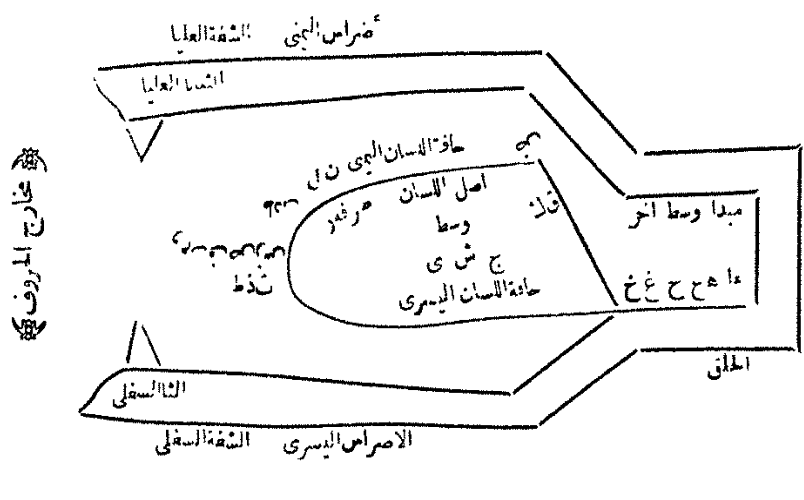
A classical schematic of the mouth and throat with Arabic letters placed at their points of articulation. Public domain, from a 1318 AH Cairo printing.
Al-Jawf
الجوفMouth & throat cavity
ا (alif) · و (waw) · ي (yaa)
The oral and throat cavity. Produces the three madd (elongation) letters, which ride on the vowel before them.
Al-Halq
الحلقThe throat
ء ه · ع ح · غ خ
Three levels: deep throat (ء ه), middle throat (ع ح), upper throat (غ خ).
Al-Lisaan
اللسانThe tongue
ق ك · ج ش ي · ض · ل ن ر · ط د ت · ص س ز · ظ ذ ث
The largest group. Different parts of the tongue produce different letters.
Ash-Shafatan
الشفتانThe two lips
ف · ب م و
Lip letters. Faa uses upper teeth on lower lip; baa and meem use both lips; waw (non-madd) uses rounded lips.
Al-Khayshoom
الخيشومThe nasal cavity
Ghunnah sound
Not a letter itself, but the resonant nasal sound held during rules like ghunnah, ikhfa, idgham with ghunnah, and iqlab.
Three Practical Zones
For day-to-day study, it helps to simplify into the three zones where most letters are produced: throat, tongue, and lips.
Throat Letters
الحروف الحلقيةء ه ع ح غ خ
Sub-zones
- Deep throatء ه
- Middle throatع ح
- Upper throatغ خ
Examples
- أَحَدaḥad
- نَعْبُدُna'budu
- غَفُورghafur
- خَالِدkhalid
Key notes
- •These letters are clear and open
- •No nasalization
- •Do not squeeze the throat
Common mistake
Replacing ع with أ
Correct
Clear throat engagement, distinct from hamzah
Tongue Letters
حروف اللسانMost Arabic letters
Sub-zones
- Back of tongueق ك
- Middle of tongueج ش ي
- Sides of tongueض
- Tip of tongueت د ط ن ل ر س ز ص ث ذ ظ
Examples
- قُلْqul
- صِرَاطṣirāṭ
- نُورnur
- رَبِّrabbi
Key notes
- •Small shifts in tongue position matter
- •Do not force pressure — accuracy over strength
- •Each letter has its own precise point
Common mistake
Collapsing multiple letters into one sound
Correct
Distinct articulation for each letter
Lip Letters
الحروف الشفويةب م ف
Sub-zones
- بFull lip closure, released cleanly
- مLip closure with nasal sound
- فUpper teeth lightly touch lower lip
Examples
- بَصِيرbaṣir
- أَمْرamr
- فِيهِfihi
Key notes
- •Gentle, controlled lip movement
- •No squeezing or tension
- •Meem engages the nasal cavity; baa does not
Common mistake
Weak or lazy lip contact, stretched lips sideways
Correct
Clean closure on baa and meem; light tooth-lip touch on faa
Practice advice
- •If you cannot hear the difference between two letters, slow down and exaggerate slightly during practice, then return to natural recitation.
- •Focus on isolated letter sounds first, then move to words, then phrases. Silent learning does not work.
- •Correct makharij preserve the Qur'an exactly as it was revealed. Tajweed rules refine the sound; makharij create it.
Recommended Practice Playlist
A clear, slow pronunciation series that focuses on isolated letter sounds and clear mouth positioning. Listen, imitate, then repeat aloud.
Learn Arabic 101 — Makharij Series
YouTube playlist · Isolated letter practice